Tarot Meditation: How to Meditate With Your Cards
Tarot is not just a divination tool — it is a meditation tool. Each card is a visual gateway into an archetypal world that your subconscious mind can explore. Here is how to use your cards for meditation and inner work.
Why Meditate With Tarot Cards?
Most people use tarot exclusively for readings — asking questions and interpreting answers. But the cards have a second function that many readers never explore: they are extraordinarily powerful meditation focal points.
Every tarot card is a densely packed visual symbol. The imagery is not decorative — it is designed to speak directly to the subconscious mind, bypassing the analytical brain and accessing deeper layers of awareness. When you sit with a single card in meditation, you enter a state where the card's symbolism unfolds within you in ways that no guidebook analysis can replicate.
Regular tarot meditation deepens your relationship with the deck in a way that simply reading about card meanings never will. After meditating with The High Priestess, for example, her energy becomes something you have felt in your body, not just something you have read about. That embodied understanding transforms your readings, making your interpretations richer, more intuitive, and more personally resonant.
Tarot meditation also provides all the standard benefits of any meditation practice — reduced anxiety, improved focus, greater self-awareness — with the added benefit of building a skill that directly improves your tarot readings.
Technique 1: Card Gazing
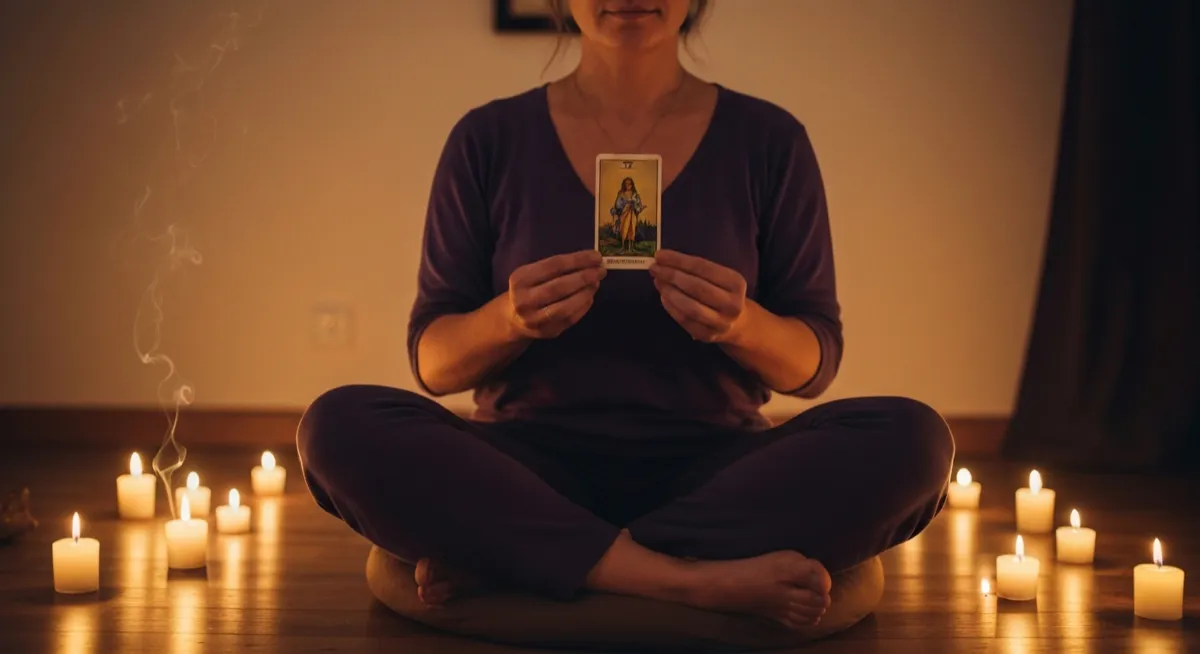
This is the simplest tarot meditation and a perfect starting point. Choose a card — you can select one intentionally or draw one at random. Prop it up in front of you or hold it comfortably in your hands at a distance where you can see the full image clearly.
Set a timer for five to ten minutes. Gaze softly at the card without trying to analyze or interpret it. Let your eyes move naturally across the image — noticing colors, shapes, expressions, background details, and the overall feeling the image evokes. Do not force your attention. Simply look, as if you were gazing at a fire or a body of water.
As you gaze, your mind will naturally begin to make associations. A color might remind you of something from your childhood. A figure's posture might mirror how you have been feeling this week. A detail you have never noticed before might suddenly seem significant. Let these associations arise without chasing them or trying to construct a narrative.
When the timer ends, close your eyes for a moment and notice what the experience felt like. Then journal briefly about what you observed and what associations came up. Over time, card gazing builds a visual vocabulary between you and the deck that makes readings feel like conversations with an old friend rather than consultations with a reference book.
Technique 2: Stepping Into the Card
This is a guided visualization technique where you imaginatively enter the world depicted on the card. It is more immersive than card gazing and produces deeper insights, but it requires comfort with closing your eyes and using your imagination.
Choose a card with a rich scene — Major Arcana cards and Court Cards work best because they have detailed imagery with characters and environments. The Star, The Moon, The Empress, and The Hermit are particularly good for this technique.
Hold the card and study it for a minute or two, absorbing as many details as possible. Then close your eyes and recreate the scene in your mind. Imagine yourself stepping through the card's border and entering the landscape. Feel the ground beneath your feet. Notice the temperature, the sounds, the quality of light.
If there is a figure in the card, approach them. Ask them a question — about your life, about the card's meaning, about anything that feels relevant. Then listen. Let the figure respond in whatever way feels natural, whether through words, gestures, emotions, or simply a feeling of understanding.
This technique can produce startlingly vivid experiences. Some people see clear images and hear distinct words. Others feel emotions or physical sensations. There is no wrong way to experience it. Whatever comes up is your subconscious mind using the card's archetypal imagery as a language to communicate with you.
Technique 3: Breathing With the Card
This technique combines breathwork with a single tarot card to create a focused, embodied meditation. It is particularly useful when you want to absorb a specific card's energy into your own life.
Choose a card whose energy you want to cultivate. If you want more courage, choose Strength. If you want more creativity, choose The Empress. If you want mental clarity, choose the Ace of Swords. The card becomes your intention made visible.
Sit comfortably with the card propped in front of you or resting on your lap. Begin a slow breathing pattern — inhale for four counts, hold for four counts, exhale for four counts, hold for four counts. As you inhale, visualize drawing the card's energy into your body through the breath. Imagine the card's colors, its warmth, its specific quality flowing into you like light.
As you exhale, visualize releasing whatever is blocking that energy in your life. If you chose Strength, exhale the fear and self-doubt that has been weakening you. If you chose The Empress, exhale the critical inner voice that stifles your creativity.
Continue for ten to fifteen breath cycles, or as long as feels right. End the meditation by placing your hands over the card and setting a simple intention: "I carry this energy with me today." Then go about your day with the card's quality as your compass.
Many readers find that the card they chose for breathing meditation appears in their readings more frequently afterward. This is not coincidence — you have tuned your subconscious to that card's frequency, and the tarot responds to that attunement.
Technique 4: The Fool's Walk Meditation
This is an extended practice done over 22 days (or 22 weeks for a deeper experience). You meditate with each Major Arcana card in sequence, starting with The Fool (0) and ending with The World (21), walking the Fool's Journey one card at a time.
Each day (or week), select the next card in the sequence. Spend your meditation time that day using any of the techniques above — gazing, stepping in, or breathing — with that card. Journal after each session about what came up and how the card's themes are showing up in your current life.
The power of this practice lies in the cumulative effect. By the time you reach The World, you have not just studied the Major Arcana intellectually — you have walked through each archetype experientially. The Fool's Journey becomes your journey, and the cards become living energies you have a personal relationship with rather than abstract concepts you have memorized.
Many readers who complete the Fool's Walk report that it fundamentally changed their reading ability. The cards no longer feel like strangers delivering messages. They feel like aspects of yourself reflecting back at you from the table.
When to Meditate With Tarot
Morning meditation with tarot is ideal if you are combining it with a daily card pull. Pull your card, spend five minutes in card gazing meditation, and then journal. This three-step morning ritual takes about ten minutes total and provides both daily guidance and meditation practice in a single sitting.
Before an important reading is another powerful time to meditate. Five minutes of silent card gazing with The High Priestess or The Hermit before a client reading (or a significant personal reading) centers your mind, opens your intuitive channels, and clears residual energy from your day.
During the full moon, pair your tarot meditation with your full moon spread for a deeply ritualistic practice. Meditate with the card in position one (what is being illuminated) to receive its message on a level deeper than intellectual interpretation.
When you are struggling with a specific card is the most important time to meditate with it. If the Five of Swords keeps appearing in your readings and you cannot figure out what it means for you, stop trying to think your way to the answer. Sit with the card. Gaze at it. Step into it. Let it show you directly what your analytical mind cannot figure out.
There is no wrong time to meditate with tarot. Even three minutes of quiet attention to a card's imagery is more valuable than thirty minutes of reading guidebook descriptions. The cards were designed to be experienced, not just studied.
Continue Exploring
More From the Blog
How to Read Tarot Cards for Beginners
Everything you need to start reading tarot cards today. From choosing your first deck to performing your first three-card spread, this guide walks you through each step without overwhelming you.
Yes or No Tarot: How It Works and What Each Card Means
Sometimes you need a straight answer. Yes or no tarot gives you one — but context matters. Learn how this popular spread works, what every card means, and when a simple yes or no is the right question to ask.
How to Shuffle Tarot Cards: 5 Methods for Every Reader
There is no wrong way to shuffle tarot cards, but some methods feel more natural than others. Here are five shuffling techniques, tips for breaking in a new deck, and how to know when to stop.