Court Cards Explained: Pages, Knights, Queens & Kings
Court cards confuse more tarot readers than any other part of the deck. Are they people? Personality traits? Messages? Here is a clear framework that makes the 16 court cards finally click.
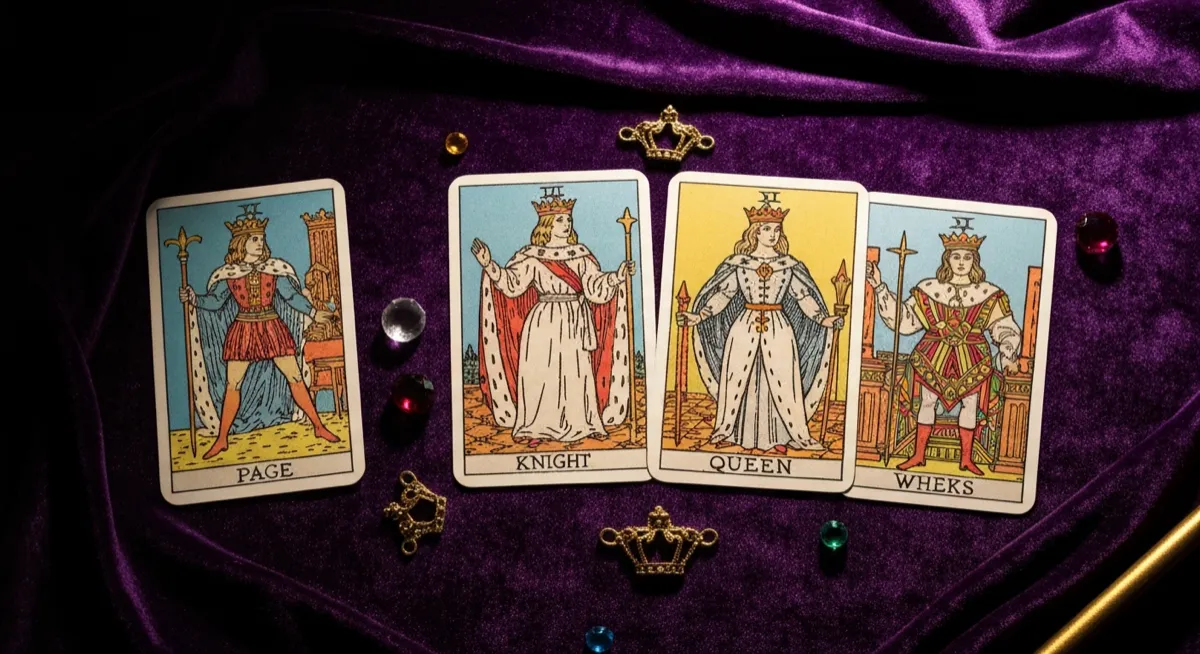
Why Court Cards Are So Confusing
Ask any tarot reader what part of the deck they struggled with longest, and the answer is almost always the court cards. There is a good reason for this: court cards operate differently from every other card in the deck, and most beginner resources do not explain that difference clearly.
Numbered cards (Ace through Ten) describe situations, energies, and events. The Five of Swords is a conflict. The Ten of Cups is emotional fulfillment. The Three of Pentacles is collaborative work. These cards tell you what is happening.
Court cards describe who is involved or what personality energy is present. They are less about what and more about who or how. This shift in function is what makes them tricky — you cannot read them the same way you read numbered cards, and if you try, the reading falls flat.
The good news is that once you understand the system, court cards become some of the most useful cards in the deck. They tell you things that no other cards can: who is influencing the situation, what approach you should take, and what stage of development you are in.
The Four Ranks: A Maturity Spectrum
The four court card ranks — Page, Knight, Queen, and King — represent four stages of maturity in how a person embodies a suit's energy. This progression is the key to understanding all 16 court cards.
Pages are the students. They represent the earliest encounter with a suit's energy — curious, enthusiastic, sometimes naive, always learning. A Page is someone (or a part of you) that is just beginning to explore the qualities of their suit. Pages can also represent actual messages, news, or the start of something new.
Knights are the activists. They have moved past the learning phase and are now charging forward with their suit's energy, sometimes recklessly. Knights bring movement, action, and pursuit. They are the part of you that does not just think about something but goes after it. The shadow of the Knight is excess — too much action without enough reflection.
Queens have internalized their suit's energy. They represent mastery through understanding, intuition, and inner authority. Queens nurture and develop their suit's qualities with depth and emotional intelligence. They influence through being rather than doing.
Kings have externalized their suit's energy. They represent mastery through leadership, action, and worldly authority. Kings direct and command their suit's qualities in the outer world. Where the Queen holds the power inward, the King projects it outward.
The Four Suits: Personality Flavors
Combine the four ranks with the four suits and you get 16 distinct personality profiles.
The Cups court (Water/Emotions) are the feeling types. The Page of Cups is a sensitive dreamer discovering their emotional depth. The Knight of Cups is a romantic idealist pursuing love and creative inspiration. The Queen of Cups is a deeply empathic, intuitive presence who understands emotions at a profound level. The King of Cups is an emotionally intelligent leader who remains calm and compassionate even in turbulent situations.
The Wands court (Fire/Passion) are the action types. The Page of Wands is an excited explorer bursting with new ideas and creative sparks. The Knight of Wands is a bold adventurer who charges after opportunities with infectious enthusiasm. The Queen of Wands is a confident, magnetic personality who inspires others through her warm and vivacious energy. The King of Wands is a visionary leader who turns bold ideas into reality through charisma and decisive action.
The Swords court (Air/Intellect) are the thinking types. The Page of Swords is a sharp, curious mind eager to learn and quick to question. The Knight of Swords charges into intellectual battles with speed and directness, sometimes cutting people with blunt honesty. The Queen of Swords is a clear-eyed truth-teller who sees through deception and communicates with precision. The King of Swords is a fair, analytical authority who makes decisions based on logic, justice, and clear thinking.
The Pentacles court (Earth/Material) are the practical types. The Page of Pentacles is a dedicated student focused on building skills and financial literacy. The Knight of Pentacles is a steady, reliable worker who gets things done through patience and persistence. The Queen of Pentacles is a nurturing provider who creates abundance and comfort through practical wisdom. The King of Pentacles is a successful, generous leader who has built material wealth through discipline and smart management.
Person, Energy, or Both?
The perennial court card debate: does a court card represent an actual person in the situation, or does it represent an energy you need to embody? The answer is: it depends on the reading, and your intuition will guide you.
When a court card represents a person, you will usually feel it. Something about the card clicks with someone specific — a partner, a boss, a friend, a family member. The Queen of Pentacles might immediately remind you of your mother. The Knight of Swords might feel exactly like your coworker who speaks before thinking. Trust those associations.
When a court card represents an energy, it is advising you on how to approach the situation. Drawing the King of Cups in an advice position is not saying "find a kind older man." It is saying "approach this situation with emotional maturity, calm, and compassion." The card is showing you the energy to embody, not a person to find.
Sometimes court cards represent both simultaneously — an actual person who is also modeling the energy you need to learn from. A Queen of Swords in your reading might refer to your therapist (the person) while also advising you to adopt her clear-eyed, honest approach to the problem (the energy).
Context clues help: court cards in "external influence" positions tend to represent other people. Court cards in "advice" or "you" positions tend to represent energy you should adopt. Court cards in "obstacle" positions might represent either a person blocking you or a personality trait within yourself that is getting in the way.
Court Cards Reversed
Reversed court cards are particularly revealing because they point to the immature, toxic, or shadow expression of a personality type.
A reversed Page shows immaturity taken to an extreme: the Page of Cups reversed might be emotionally manipulative or lost in fantasy; the Page of Swords reversed might be a gossip or someone who uses information to harm others.
A reversed Knight shows recklessness or stagnation: the Knight of Wands reversed is either charging ahead without any plan or, paradoxically, has lost all motivation and cannot get started. Knights reversed often indicate that action is needed but the approach is wrong.
A reversed Queen shows her nurturing power twisted: the Queen of Pentacles reversed might be so focused on material security that she neglects emotional connections, or she might be financially reckless despite appearing capable. Reversed Queens often indicate that inward mastery has been compromised.
A reversed King shows authority corrupted: the King of Swords reversed becomes a tyrannical intellectual bully; the King of Wands reversed becomes an arrogant leader who takes credit for others' work. Reversed Kings are the most cautionary court cards in the deck because they show what happens when power is wielded without integrity.
When you draw a reversed court card, ask yourself honestly: is this describing someone in my life, or is this describing a pattern in my own behavior? The answer is often uncomfortable and always valuable.
Quick Tips for Reading Court Cards
Notice which suits dominate your court card appearances. If you keep pulling Swords court cards, your situation is primarily intellectual or conflict-driven. If Cups court cards keep showing up, emotions and relationships are the central theme. The suit pattern is as informative as the individual card.
Compare court cards within the same reading. If the Queen of Cups and the Knight of Swords both appear, there is a tension between emotional depth and intellectual aggression in the situation. The interplay between court cards tells you about relationship dynamics and internal conflicts.
Do not force a gender onto court cards. Queens can represent men. Kings can represent women. The rank describes the energy, not the gender of the person. A nurturing, emotionally intelligent father is a Queen of Cups. A decisive, authoritative woman running a company is a King of Pentacles. Let go of gendered assumptions and the cards will speak more accurately.
When in doubt, ask the card directly: "Who are you in this reading?" Then notice the first person or quality that comes to mind. Court cards respond especially well to this direct intuitive inquiry because they are, in a sense, characters with personalities. They want to be recognized.
Continue Exploring
More From the Blog
How to Read Tarot Cards for Beginners
Everything you need to start reading tarot cards today. From choosing your first deck to performing your first three-card spread, this guide walks you through each step without overwhelming you.
Yes or No Tarot: How It Works and What Each Card Means
Sometimes you need a straight answer. Yes or no tarot gives you one — but context matters. Learn how this popular spread works, what every card means, and when a simple yes or no is the right question to ask.
How to Shuffle Tarot Cards: 5 Methods for Every Reader
There is no wrong way to shuffle tarot cards, but some methods feel more natural than others. Here are five shuffling techniques, tips for breaking in a new deck, and how to know when to stop.